The Beautiful Game Has an Ugly Business Model
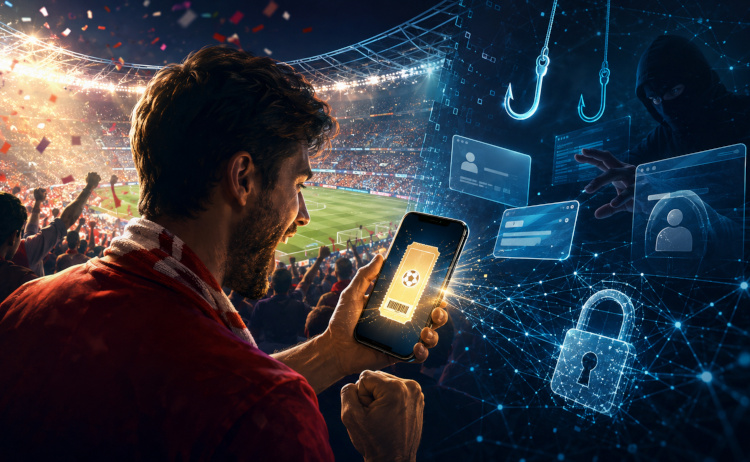
The first of the World Cup scams does not look like a scam. It looks like a countdown clock.
It looks like a clean checkout page with the right colors, the right logo, the right stadium photo, and the promise every desperate football fan wants to believe: final tickets available. It arrives in the emotional dead zone between hope and panic, when a fan has already imagined the walk to the stadium, the noise, the anthem, the once-in-a-lifetime story they will tell for years.
That is when the criminal enters the match. SANS Institute’s OUCH! newsletter warns that global events such as the World Cup create ideal conditions for fraud because demand is high, emotions are intense, and people act quickly around tickets, travel, merchandise, and streaming access. That is the polite version. My less polite version is this: major sporting events have become industrial-scale phishing lures with fireworks, flags, and corporate sponsors (SANS Institute). And fans are not careless. They are human.
Cybercriminals do not hack the World Cup. They hack the fan.
The World Cup is a perfect crime scene because nobody wants to slow down. A parent wants to take a child to their first match. A group of friends wants seats together. A business traveler needs accommodation before prices explode. A supporter living abroad wants a reliable stream. Every decision feels urgent. Every offer feels temporary. Every missed opportunity feels personal.
That urgency is the attacker’s real exploit. The FBI warned in May 2026 that threat actors were spoofing FIFA-related websites ahead of the 2026 World Cup to collect personal information, sell fake tickets and hospitality products, and enable other malicious activity. The mechanics are depressingly familiar: create a deceptive version of a trusted site, wrap it in official-looking branding, then wait for fans to confuse recognition with trust. (Internet Crime Complaint Center)
This is why I think the old advice, “watch for spelling mistakes”, is dangerously outdated. Scammers no longer need to look amateur. With modern design templates, automated translation, stolen brand assets, and AI-assisted copy, fraud can look smoother than the official experience. A beautiful website proves nothing. A convincing email proves nothing. A logo proves nothing.
In 2026, “it looks real” is not a security test. It is a vulnerability.
The fake ticket is only the beginning
Ticket fraud gets the headlines because it hurts immediately. You pay. You arrive. The barcode fails. The dream collapses at the gate. But the more sinister scam is the one that keeps scoring long after match day.
A fake streaming site may ask for an email address, password, phone number, or payment card “for verification.” A fake merchandise shop may harvest card details. A fake hospitality seller may collect passport information. A fraudulent travel offer may push victims toward irreversible payment methods. SANS specifically warns about scams involving tickets, travel, fake streaming, counterfeit merchandise, and fraudulent giveaways around World Cup fever.
That means the victim may not simply lose money. They may hand over the ingredients for identity theft. A recent research on 2026 World Cup scams found abuse of FIFA and World Cup branding across phishing, fake ticket sales, betting scams, social media offers, Telegram channels, coordinated domains, and cybercriminal forum activity. In other words, this is not a few opportunists with fake PDFs. It is an ecosystem.
And here is the uncomfortable truth: the scam economy is often more agile than the legitimate fan experience. Fraudsters do not need procurement approvals, brand reviews, legal sign-off, or customer-service scripts. They launch, test, clone, vanish, and relaunch. They are not trying to serve millions of fans. They are trying to fool a fraction of them.
At World Cup scale, a fraction is enough.
The official marketplace matters although confusion is part of the danger
FIFA has official channels for tickets, hospitality, resale, and exchange. Its own guidance advises fans to purchase World Cup 2026 tickets and ticket-inclusive packages through official channels and authorized resellers. FIFA also announced an official resale/exchange marketplace for fans buying and selling tickets originally purchased by others.
That should be reassuring. But it also reveals the problem. The modern ticketing journey is fragmented: official sales, hospitality packages, resale windows, transfer rules, apps, queues, dynamic prices, regional rules, emails, fan IDs, travel bundles, and secondary markets. Complexity creates fog. Scammers live in fog.
When the legitimate process is confusing, the fraudulent process can feel refreshingly simple. That is the provocation event organizers need to hear: bad user experience is now a security risk. If official channels are difficult to understand, fans will search elsewhere. If pricing feels opaque, fans will chase “insider” offers. If support is slow, scammers will answer faster. If rules are buried, criminals will write cleaner instructions.
Security is not just a fraud-warning page. Security is clarity.
Payments are where the mask slips
The fastest way to spot many scams is not the logo, the domain, or even the story. It is the payment method. The FTC warns that people should never pay someone who insists on cryptocurrency, wire transfer, payment apps, or gift cards; these methods are favored by scammers because they are difficult or impossible to reverse. The FTC gives similar advice for travel scams, warning against sellers who demand wire transfers, gift cards, cryptocurrency, or payment apps.
That advice should be printed on every fan’s brain:
- When the seller says, “Pay fast,” slow down.
- When the seller says, “Use crypto,” walk away.
- When the seller says, “Friends and family payment only,” assume you have no friend there.
- When the seller says, “Trust me,” verify somewhere else.
The Better Business Bureau also advises consumers buying high-demand event tickets to use payment methods with protection, especially credit cards, and to be wary of ads for cheap tickets that appear in online searches.
My personal rule is harsher: if a stranger is selling access to a life-changing event and the transaction has no meaningful buyer protection, I treat the offer as hostile until proven otherwise.
Not suspicious. Hostile. That mindset may sound unreasonable. It is not. It is what realism looks like when fraud has professionalized.
The five-minute pause may be the best cybersecurity tool fans have
Cybersecurity people love tools: password managers, MFA, browser protection, domain monitoring, takedown services, fraud analytics. All useful. None of them fully neutralize the emotional moment when someone thinks they are about to lose the chance of a lifetime.
So here is the simplest defense: create friction. Before buying a ticket, booking a “special” travel package, entering card details for a streaming offer, or clicking a World Cup giveaway, pause for five minutes. Not one minute. Five.
During that pause, ask:
- Did I reach this site independently, or did someone push me here through an email, ad, message, or social post?
- Is this seller named by an official source?
- Does the payment method protect me?
- Would this offer still seem credible if I were not excited, rushed, or afraid of missing out?
That last question matters most. Scammers do not merely steal credentials. They borrow your imagination. They let you picture the seat, the goal, the shirt, the memory; then they charge admission to a fantasy.
The industry needs to stop blaming only the victim
Yes, fans must be skeptical. Yes, they should use unique passwords, enable multi-factor authentication, avoid suspicious links, and purchase only through official or reputable channels. But let us not pretend this is only a consumer-awareness problem.
Search engines profit from ads. Social platforms profit from engagement. Payment platforms profit from transaction volume. Event organizers profit from scarcity. Ticketing ecosystems profit from complexity. Somewhere in that chain, criminals find oxygen.
My opinion: major sports bodies and their commercial partners should treat fraud prevention as part of the event infrastructure, not a footnote. That means visible scam warnings at the moment of purchase, aggressive takedowns of impersonation sites, verified reseller directories that are easy to understand, multilingual public alerts, and rapid reporting channels that ordinary fans can actually use.
A fan should not need to become a cyber investigator to buy a ticket. The current model often asks consumers to navigate a maze and then blames them for taking the wrong turn. That is not good enough.
The final whistle
The World Cup sells belonging. That is why it is beautiful. It is also why it is exploitable. A scammer does not see a fan. A scammer sees urgency, identity, loyalty, scarcity, and a payment method. They see a person whose defenses are lowered by joy.
That is what makes World Cup scams so cruel. It contaminates something communal. It turns anticipation into suspicion. It makes people afraid of the very excitement that sport is supposed to create. But fans are not powerless. The winning move is not cynicism. It is disciplined enthusiasm.
Cheer loudly. Travel boldly. Wear the shirt. Book the trip. Watch the match. But when money, identity, passwords, or tickets enter the conversation, slow the game down. Because in the World Cup’s shadow tournament, the most dangerous striker is not wearing boots. He is sending you a link.