
Implementing the New NIST CSF 2.0
A Comprehensive Roadmap for Cybersecurity Risk Management
The National Institute of Standards and Technology (NIST) released Version 2.0 of its Cybersecurity Framework (CSF) in February 2024. The new version is marking a major evolution in the way organizations manage cybersecurity risk. Since its initial release in 2014, the NIST CSF has served as a foundational tool for aligning cybersecurity activities with business requirements, risk tolerances, and resources. Implementing the new NIST Cybersecurity Framework 2.0 represents a thoughtful and strategic response to the shifting threat landscape, the growing complexity of digital ecosystems, and the increasing regulatory scrutiny surrounding data protection and information security.
This article provides an in-depth exploration of the changes introduced in NIST CSF 2.0, analyzes the implications of its new components, and outlines a structured methodology for effective implementation across diverse organizational contexts. The objective is to equip information security professionals, risk managers, and enterprise leaders with the insight necessary to leverage the framework as a core component of their cybersecurity strategy.
Key Enhancements in NIST CSF 2.0
Introduction of the “Govern” Function
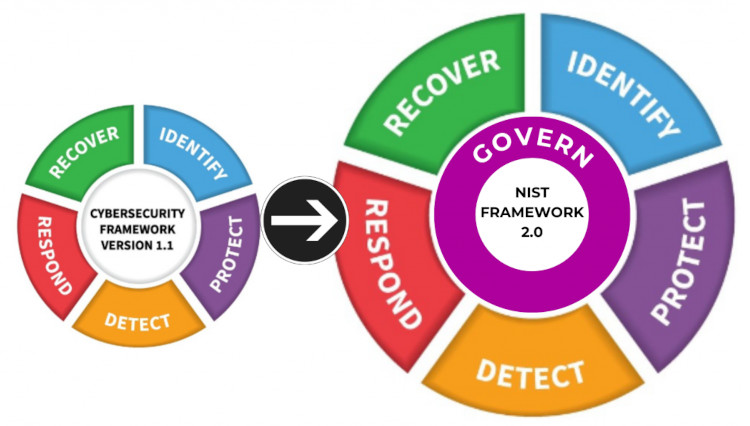
The most conspicuous structural change in CSF 2.0 is the addition of a sixth high-level function: “Govern.” This new function addresses a longstanding gap by formally embedding governance considerations into the cybersecurity framework. It underscores that cybersecurity is not simply a technical domain, but a critical component of enterprise governance and risk management.
The “Govern” function comprises categories that focus on establishing organizational context, defining cybersecurity roles and responsibilities, developing policies and procedures, and integrating cybersecurity risk management into broader enterprise risk activities. These categories reflect the imperative for executive oversight, board-level awareness, and cross-functional alignment in cybersecurity decision-making.
Expansion and Refinement of Existing Functions
The core structure of the original five functions (Identify, Protect, Detect, Respond, and Recover) remains intact. CSF 2.0 introduces refined outcomes and expanded subcategories that reflect contemporary cybersecurity challenges. In particular, the “Respond” and “Recover” functions have been enriched to include more granular guidance on post-incident activities such as forensic analysis, lessons learned, and coordination with external stakeholders.
Enhanced Alignment with Risk and Compliance Frameworks
Version 2.0 reinforces interoperability with other standards and frameworks, including ISO/IEC 27001, COBIT, and the NIST Risk Management Framework (RMF). The expanded Informative References and implementation examples provide a robust mapping between CSF outcomes and requirements in these frameworks, thereby enabling organizations to use CSF as a centralized lens through which to align multiple regulatory and compliance obligations.
Emphasis on Supply Chain and Third-Party Risk
CSF 2.0 includes expanded guidance on managing risks stemming from third-party service providers and supply chain dependencies. Cybersecurity risk often originates outside an organization’s direct control. To address this, the framework integrates supply chain risk management into all six functions. It emphasizes the need for contractually enforced security requirements, continuous monitoring, and clear escalation protocols.
Usability Improvements and Sector-Specific Guidance
To increase accessibility and applicability, NIST has released companion Quick Start Guides and sector-specific resources. These tools translate high-level concepts into actionable steps tailored for organizations of varying sizes and maturity levels, from small and medium enterprises (SMEs) to large, regulated entities in critical infrastructure sectors.
Methodology for Implementing NIST CSF 2.0
Implementing the new NIST Cybersecurity Framework 2.0 effectively requires a structured and deliberate approach that considers organizational context, resource constraints, and strategic objectives. The following methodology provides a roadmap for aligning cybersecurity practices with the framework:
Establish Executive Buy-In and Governance Structure
Successful implementation begins with leadership. Executive sponsorship ensures that cybersecurity is treated as a strategic business function, not merely a technical one. Organizations should appoint a governance body, such as a cybersecurity steering committee. In this, Information Technology, Risk, Legal, Compliance, and Business Units need to participate to oversee implementation efforts.
Perform a Baseline Assessment
A comprehensive gap analysis should be conducted to assess the organization’s current cybersecurity posture against the CSF 2.0 Core. This involves mapping existing controls and processes to the subcategories in each of the six functions, identifying areas of strength and areas requiring improvement.
Develop a Target Profile
The results of the baseline assessment is a very powerful tool. Using it, the organization may define a Target Profile that reflects its desired cybersecurity outcomes, based on mission objectives, threat environment, and legal/regulatory requirements. The Target Profile serves as a blueprint for strategic planning and investment.
Prioritize Gaps and Develop an Implementation Plan
Organizations must prioritize remediation efforts based on risk impact, resource availability, and dependencies. Implementation plans should include clearly defined projects, timelines, responsible parties, and performance metrics. Also, Particular attention should be paid to “Govern” function elements, as these lay the foundation for sustainable cybersecurity governance.
Execute, Monitor, and Adjust
Implementation should be iterative, with continuous monitoring of progress and adaptation to changing conditions. Metrics and key performance indicators (KPIs) should be established to assess effectiveness. In addition, periodic reviews should be conducted to refine the implementation approach.
Institutionalize Continuous Improvement
Cybersecurity is not a one-time initiative. CSF 2.0 encourages a lifecycle approach, where lessons learned from incidents and evolving threat intelligence inform policy updates, training programs, and control enhancements. This continuous improvement loop ensures resilience and agility in the face of new threats.
Conclusion
NIST CSF 2.0 represents a significant advancement in the maturation of cybersecurity risk management. By expanding its scope, introducing governance principles, and offering deeper guidance across all functions, the updated framework provides a more holistic and adaptable tool for managing cybersecurity challenges.
As cyber threats grow more sophisticated and regulatory demands intensify, organizations must adopt frameworks that not only protect critical assets but also align with strategic objectives and demonstrate accountability. The CSF 2.0 provides that scaffolding. Its successful implementation requires a commitment to governance, cross-functional collaboration, and continuous refinement. However the payoff is a more resilient, transparent, and strategically integrated cybersecurity posture.
For technical leaders, Chief Information Security Officers (CISOs), and Risk Managers, NIST CSF 2.0 is not merely a framework. It is a mandate for systemic change, a guide for decision-making, and a blueprint for building trust in the digital age. Implementing the new NIST Cybersecurity Framework 2.0 is a useful tool in everyone cybersecurity arsenal.


