The Worm That Taught the World Trust was a Vulnerability
The Morning the Internet Changed Forever
On May 4, 2000, the internet stopped being an optimistic communications platform and became a live demonstration of how easily human behavior could be weaponized at planetary scale, through the ILOVEYOU worm outbreak.
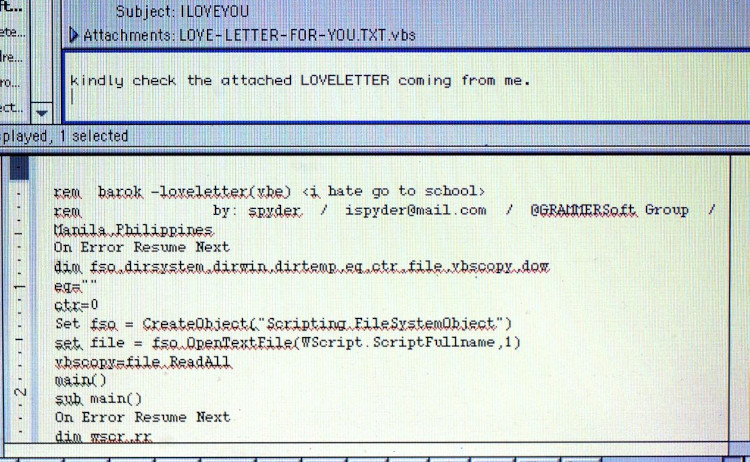
The “ILOVEYOU” worm arrived through email with a subject line so simple, so emotionally disarming, and so universally relatable that millions of users opened it without hesitation, allowing a relatively unsophisticated Visual Basic Script to spread across governments, multinational corporations, financial institutions, media organizations, and telecommunications networks within hours.
The ILOVEYOU worm outbreak caused billions of dollars in damages, but the financial losses tell only part of the story, because the real impact emerged from a deeper realization: cybersecurity professionals had spent years focusing on systems, networks, and code while attackers quietly discovered that the most scalable vulnerability in cyberspace was human trust.
A Love Letter that Carried Destruction
The ILOVEYOU worm outbreak attack used a brilliantly simple delivery mechanism.
Users received an email with the subject “ILOVEYOU” and an attachment named “LOVE-LETTER-FOR-YOU.TXT.vbs.” Microsoft Windows hid known file extensions by default, so most recipients saw what appeared to be a harmless text document instead of an executable script. That single interface decision became one of the most consequential usability failures in cybersecurity history.
Once users opened the attachment, the worm executed immediately, harvested Microsoft Outlook contacts, replicated itself through outbound email messages, modified registry keys for persistence, overwrote files across local and mapped drives, and downloaded credential-stealing components from remote servers.
The malware spread with extraordinary speed because it exploited existing trust relationships instead of forcing technical compromise through advanced exploitation chains. Every infected user unknowingly became an operational amplifier for the attack.
The Malware Was Simple; the Psychology Was Revolutionary.
The technical sophistication of the worm was modest even by the standards of 2000. The strategic brilliance, however, came from its understanding of human behavior.
Attackers recognized that emotional triggers outperform technical deception at scale. Curiosity, intimacy, urgency, fear, and trust consistently bypass rational skepticism faster than technical exploits bypass software controls. That principle still defines modern cyber operations.
Today’s adversaries use the same psychological framework in business email compromise campaigns, OAuth consent phishing attacks, MFA fatigue operations, malicious collaboration-platform invitations, and AI-generated spear-phishing messages whose linguistic quality increasingly resembles authentic corporate communication.
The tooling evolved dramatically. The operational philosophy never changed.
The Cybersecurity Industry was Caught Unprepared
At the time of the outbreak, enterprise security architectures lacked the visibility and resilience that modern defenders now consider foundational. Endpoint protection relied heavily on signature-based detection. Threat intelligence sharing remained immature. Security operations centers operated with limited telemetry. Behavioral analytics barely existed. Most organizations trusted email implicitly.
The internet itself also lacked defensive maturity. Enterprises connected systems aggressively while investing minimally in segmentation, centralized monitoring, script execution controls, or coordinated incident response capabilities. When the worm spread globally, defenders discovered that traditional perimeter security models could not contain attacks moving at internet speed. Many organizations disconnected mail infrastructure entirely in desperate attempts to stop propagation.
For the first time, executives witnessed cyber disruption producing operational paralysis across critical business functions in real time. Cybersecurity stopped being viewed as a technical support issue and became a board-level risk discussion almost overnight.
ILOVEYOU Created the Blueprint for Modern Social Engineering
The worm transformed cybersecurity thinking because it proved that attackers no longer needed elite technical capability to achieve strategic impact. A simple script combined with effective social engineering generated consequences severe enough to disrupt governments and global enterprises simultaneously.
That realization democratized offensive cyber operations. Modern ransomware groups, phishing-as-a-service platforms, criminal affiliate ecosystems, and influence operations all rely on the same core insight: scalable human manipulation often produces greater operational return than sophisticated technical exploitation.
ILOVEYOU exposed this reality decades before “human-centric security” became an industry phrase.
The Real Failure was Systemic, Not Human
For years, users received most of the blame for opening the attachment. That interpretation missed the larger issue.
Organizations normalized insecure defaults across the entire technology stack. Email clients executed risky content too easily. Operating systems concealed executable extensions. Enterprises allowed unrestricted scripting environments. Networks lacked segmentation. Outbound communications faced minimal inspection.
Users operated inside ecosystems designed without meaningful resilience against socially engineered abuse.
The lesson still matters today. Security awareness training alone cannot compensate for insecure-by-default environments. Human behavior always fluctuates under stress, distraction, urgency, or emotional influence. Effective security architectures assume that reality instead of denying it.
That philosophy eventually drove adoption of defense-in-depth models, attachment filtering, least-privilege access, behavioral monitoring, sandboxing, application controls, and eventually zero-trust frameworks.
The Worm Also Changed Cyber Law
The attack originated in the Philippines, where cybercrime legislation at the time failed to address malware distribution adequately. Investigators identified suspected creators, but prosecutors struggled because existing laws did not clearly criminalize the activity.
The incident exposed a dangerous gap between technological capability and legal preparedness. Governments around the world responded by accelerating cybercrime legislation, international investigative cooperation, digital evidence procedures, and cross-border law enforcement frameworks.
The ILOVEYOU worm outbreak demonstrated that cyber threats ignore geography by design. Legal systems had to evolve accordingly.
Before Ransomware, There was ILOVEYOU
Modern cybersecurity discussions often focus on ransomware, nation-state operations, supply-chain compromise, AI-enabled phishing, and cloud-native attack surfaces.Yet many foundational concepts behind those threats appeared clearly during the ILOVEYOU outbreak.
The worm weaponized trust. It leveraged automation for scale, while it abused legitimate platform functionality, propagating through interconnected communications systems. But most importantly, it combined technical compromise with psychological manipulation.
Every major modern cyber campaign still follows that model in one form or another.
The Legacy That Still Shapes Cybersecurity
More than two decades later, the phrase “I LOVE YOU” still symbolizes one of cybersecurity’s most uncomfortable truths: people do not separate emotion from technology interactions nearly as effectively as security models often assume.
Attackers understand this deeply. Defenders sometimes forget it.
The worm’s lasting significance does not come from technical innovation. It comes from the strategic clarity it delivered. The attack revealed that cybersecurity failures rarely emerge from isolated software weaknesses alone. They emerge from the intersection of human behavior, insecure design choices, organizational assumptions, operational complexity, and adversarial creativity. That reality remains unchanged.
Every collaboration platform, cloud ecosystem, AI assistant, messaging application, and digital workflow introduced today creates new trust relationships that adversaries will eventually attempt to weaponize.
ILOVEYOU simply exposed the pattern before the rest of the industry was ready to see it.