When Digital Risk Became Operational Reality
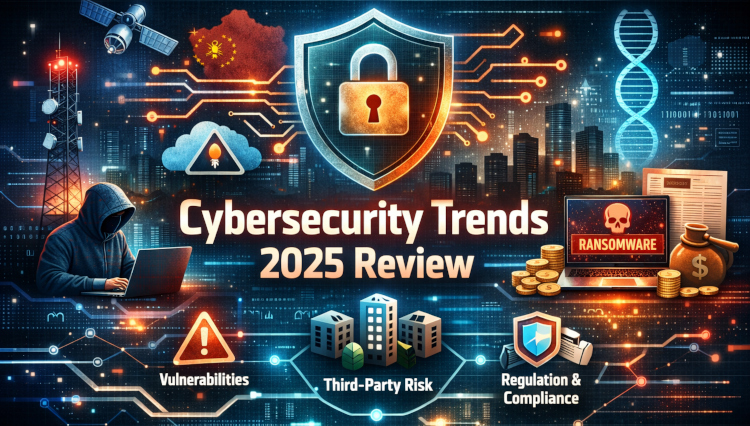
The 2025 cybersecurity trends review revealed that, cybersecurity and privacy risks ceased to be abstract or isolated technical concerns and instead manifested as systemic, real-world disruptions. From espionage embedded in telecommunications infrastructure to ransomware events affecting entire sectors, and from identity-driven intrusions to the fragility of shared security ecosystems, the year demonstrated that digital risk is now inseparable from operational resilience. At the same time, privacy challenges evolved beyond compliance into questions of data ownership, lifecycle, and institutional stability. Together, these developments marked a turning point: cybersecurity became not just a defensive discipline, but a core element of system and organizational design.
From Crisis to Normalcy
If 2024 was the year organizations learned to expect constant cyber crises, 2025 cybersecurity trends review showed that this was the year those crises became routine. The defining characteristic of the cybersecurity landscape was not a single catastrophic breach, but the steady normalization of systemic risk. Attackers refined their methods, defenders matured unevenly, and the boundary between cyber incidents and real-world consequences effectively disappeared.
Several macro-trends converged: the weaponization of telecommunications infrastructure, the scaling of ransomware into operational disruption, the fragility introduced by third-party dependencies, and the transformation of privacy from a compliance issue into a business continuity concern. The result was a year where cybersecurity ceased to be a specialized discipline and became a fundamental property of how modern systems function.
Telecommunications as a Battlespace
One of the most consequential developments in 2025 was the continued exposure of telecommunications networks as strategic intelligence targets. Campaigns such as Salt Typhoon underscored how deeply state-sponsored actors had penetrated global communications infrastructure.
Rather than focusing solely on traditional espionage targets, attackers embedded themselves within the fabric of network providers, enabling persistent access to sensitive data flows. This marked a shift from episodic intrusions to continuous intelligence collection. Telecommunications systems were no longer neutral conduits; they became contested terrain.
For defenders, this changed the threat model fundamentally. Trust assumptions about core infrastructure eroded, and security strategies increasingly had to account for adversaries already present within network layers previously considered reliable.
The Fragility of Shared Security Infrastructure
In April 2025, the near-disruption of the CVE program highlighted an often-overlooked reality: global cybersecurity depends on a small number of shared institutions. The CVE system, which underpins vulnerability identification and coordination worldwide, came close to operational instability due to administrative uncertainty.
Although the issue was ultimately resolved, the episode exposed how fragile the ecosystem is. Vulnerability management pipelines; scanners, advisories, patching workflows are tightly coupled to centralized identifiers. Any disruption to that system would have cascading effects across industries.
This was not a technical failure, but a governance one. It demonstrated that cybersecurity resilience depends not only on code and controls, but also on sustained institutional support.
Ransomware as Systemic Disruption
Ransomware continued to evolve beyond data encryption into full-scale operational disruption. The Change Healthcare incident exemplified this shift. What began as a cyberattack quickly propagated into a nationwide healthcare crisis, affecting claims processing, pharmacies, providers, and ultimately patients.
The significance of the incident lay in its systemic impact. A single compromised entity, deeply embedded in sector workflows, became a single point of failure for an entire industry. This reflected a broader pattern in 2025: attackers increasingly targeted centralized service providers whose disruption would cascade outward.
Ransomware was no longer just a security problem; it became an availability and continuity problem at national scale.
Identity as the Weakest Link
While advanced threats dominated headlines, many high-impact incidents in 2025 relied on surprisingly simple entry points. Social engineering against IT help desks emerged as a recurring theme.
The attacks on major UK retailers demonstrated how attackers could bypass technical defenses by exploiting human processes. By impersonating employees and convincing support staff to reset credentials, attackers gained privileged access without needing sophisticated exploits.
This reinforced a critical lesson: identity systems are only as strong as their weakest operational interface. Even organizations with mature technical controls remained vulnerable if identity verification processes were insufficiently hardened.
Third-Party Risk and Cascading Breaches
Third-party dependencies became one of the most significant risk multipliers of the year. The PowerSchool breach illustrated how a single compromise could propagate across hundreds of downstream organizations, in this case, schools and districts, amplifying both impact and monetization opportunities.
Attackers increasingly exploited this structure. Rather than targeting individual victims, they focused on platforms that aggregated data or services. Once breached, these platforms enabled repeated extortion attempts against multiple parties.
This model transformed breaches into ongoing campaigns rather than isolated events, with secondary and tertiary victims continuing to feel the impact long after the initial compromise.
Privacy in the Age of Organizational Instability
Perhaps the most important shift in 2025 was the reframing of privacy. Traditionally treated as a regulatory or compliance issue, privacy became inseparable from organizational resilience.
The case of 23andMe highlighted this transformation. As the company entered bankruptcy proceedings, concerns emerged not just about how data had been protected, but about what would happen to it next. Genetic data, which are arguably among the most sensitive categories of personal information suddenly became an asset subject to transfer, sale, or restructuring.
This raised a new class of questions: Who controls data when companies fail? How durable are privacy commitments under financial stress? And what protections exist when data outlives the entity that collected it?
Privacy was no longer just about collection and use; it became about lifecycle, ownership, and institutional continuity.
Regulation Moves from Framework to Enforcement
Regulatory developments in 2025 reflected a shift from guidance to enforcement. In Europe, the Digital Operational Resilience Act (DORA) came into application, formalizing requirements for operational resilience in financial services. At the same time, delays in NIS2 transposition triggered direct action against member states.
Notably, enforcement extended beyond private organizations. A landmark court decision held a public institution accountable for improper data transfers, signaling that regulatory obligations apply universally. This marked a maturation of the regulatory environment. Cybersecurity and privacy were no longer aspirational goals but enforceable obligations with tangible consequences.
Cybersecurity as System Design
The overarching lesson of 2025 was not the emergence of new threats, but the confirmation of existing realities under pressure. Cybersecurity proved to be inseparable from system architecture, business dependencies, identity management, and data governance.
Organizations that treated cybersecurity as an integrated property of their systems rather than a specialized function, were better positioned to absorb shocks. Those that did not found themselves exposed not just to breaches, but to operational and financial disruption.
In that sense, 2025 was less a year of surprises and more a year of validation. It demonstrated, conclusively, that cybersecurity is no longer about defending systems at the edges. It is about designing systems that remain resilient when those edges inevitably fail. And this would the key takeaway of the 2025 cybersecurity trends review.