From Firewall Guardians to Boardroom Strategists
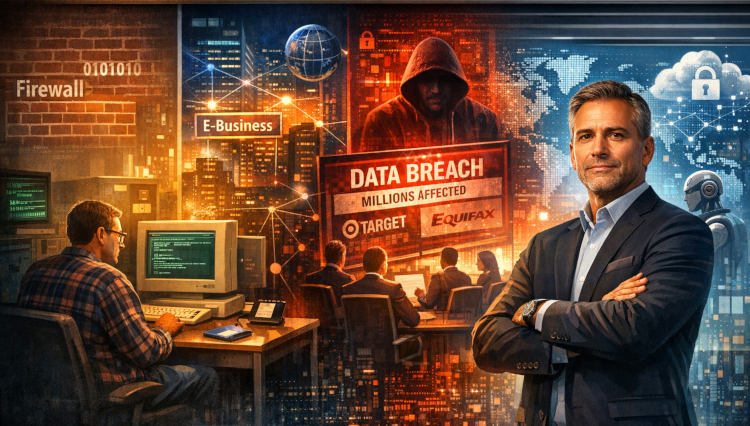
In the early days of corporate computing, security wasn’t glamorous. It lived quietly in server rooms and behind terminal screens, handled by system administrators who were far more concerned with uptime than adversaries. There were no headlines about data breaches, no ransomware countdown clocks, and certainly no seat at the executive table for security leaders. And yet, from these modest beginnings, one of the most critical roles in modern business would emerge: the Chief Information Security Officer. This is the story of the CISO.
The Moment Everything Changed
The story of the Chief Information Security Officer (CISO) begins in 1994, when a subtle but significant shift took place. At Citigroup (then Citi Corp.), a new title started circulating: Chief Information Security Officer.
A year later, in 1995, the company formalized the role by hiring Steve Katz, widely recognized as the world’s first Chief Information Security Officer. Katz wasn’t brought in to chase hackers or respond to incidents in the way we think of today. His mission was more foundational:
- Build a new kind of security office
- Design secure architectures
- Make technology itself more resilient
At the time, cybersecurity wasn’t yet a battlefield; it was an engineering problem. The idea was simple: if systems were designed securely from the start, threats could be minimized.
Riding the Dot-Com Wave
By the year 2000, the internet had transformed from a novelty into a business necessity. Companies were rushing online, forming digital partnerships, and exchanging data across organizational boundaries.
With that shift, the Chief Information Security Officer’s responsibilities expanded rapidly. No longer confined to internal systems, Chief Information Security Officers were now expected to oversee:
- E-business alliances
- Cross-institutional data exchanges
- The security of interconnected digital ecosystems
This was the first time the role extended beyond the organization’s perimeter. Trust became a shared responsibility; and a shared risk.
A Role in Flux
Then came 2001. The economic downturn forced companies to reassess priorities, budgets, and risk tolerance. Security teams were no exception. For many organizations, cybersecurity spending had to be justified more rigorously than ever before. Ironically, this period of constraint helped stabilize the Chief Information Security Officer role.
As cyber threats grew more capable, and the potential for disruption more obvious, leaders began to recognize that security wasn’t optional. It was essential. Chief Information Security Officers found themselves:
- Defending budgets with business cases, not just technical arguments
- Explaining risk in terms executives could understand
- Navigating shifting responsibilities as organizations restructured
After several years of uncertainty and reshuffling, the role began to solidify. It was no longer experimental. It was necessary.
When Cybersecurity Hit the Headlines
Fast forward to the 2010s, and cybersecurity had entered the public consciousness in a dramatic way.
Major breaches at companies like Target and Equifax exposed millions of records and cost billions in damages. But perhaps more importantly, they shattered the illusion that cybersecurity failures were purely technical issues. They were business crises.
Suddenly, boards wanted answers. CEOs wanted accountability. Customers demanded trust. And the Chief Information Security Officer? They were at the center of it all.
The Transformation of the Chief Information Security Officer
Over time, the role underwent a profound transformation. What was once a technically focused, often stereotyped “geeky” position buried deep in IT evolved into something far more complex; and far more visible.
Today’s Chief Information Security Officer is:
- A risk executive translating cyber threats into business impact
- A strategist shaping organizational resilience
- A communicator bridging technical teams and boardrooms
- A crisis leader during incidents that unfold in real time
It’s no longer enough to understand firewalls and encryption. Modern Chief Information Security Officers must understand finance, regulation, geopolitics, and human behavior. In many organizations, they now sit at the executive level, advising leadership and influencing decisions that shape the entire business.
The Modern Reality: Security as Strategy
In recent years, the evolution has accelerated even further. The rise of cloud computing, remote work, ransomware, and nation-state attacks has made cybersecurity both more complex and more critical. At the same time, regulatory pressure and public scrutiny have intensified.
The Chief Information Security Officer is no longer just protecting systems. They are safeguarding:
- Brand reputation
- Customer trust
- Operational continuity
And perhaps most importantly, they are helping organizations accept a difficult truth: breaches may be inevitable, but resilience is a choice.
Looking Ahead
The journey and story of the CISO is far from over.
As artificial intelligence reshapes both attack and defense, and as global tensions spill into cyberspace, the role will continue to evolve. But one thing is clear.What began in the 1990s as an effort to make technology more secure has become a cornerstone of modern leadership.
The Chief Information Security Officer is no longer just a guardian of systems. They are a guardian of the business itself.